
|
|
|
|
C&W - Stock Lists: Carriages & Wagons - C&W News - SR Coach Group - Goods Division - Operation Undercover - Technical - Join us 

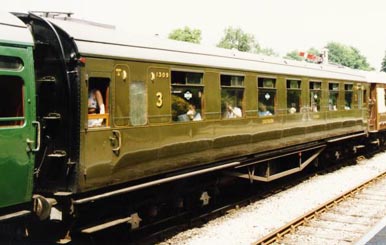
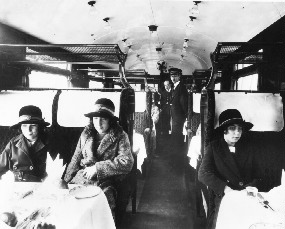
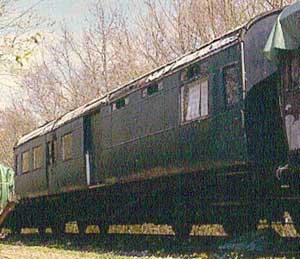
Carriage Fleet Review - 3Maunsell CoachesThis third article in the series considers those of our coaches designed by Richard Maunsell for the Southern Railway. These thirteen coaches could be described as "the core" of our collection. They are the coaches which were associated with many of our locomotives during their working lives, and they fall chronologically between the vintage, non-corridor stock, and the "modern" (i.e. post-war) Bulleid and Mk.1 stock. All are constructed with a wooden body with steel panelling over this. The main weakness in the design is that water ingress around the windows causes the bottom rail to split where the bolts through it rust. This problem is worse than in our older coaches since the quality of the timber originally used was not as good. The advantages of this stock from an operational viewpoint are that it is corridor stock, and have fewer doors per coach than the older stock. Open Third No. 1309, (Built 1935)
Now, after more than two decades of service it continues to perform as one of our most intensively used coaches, and is standing up to this remarkably well. If only the qualities of the design had been more fully appreciated at the time when No.1306 was raided for spare parts for the restoration of 1309 - we might have had two of these superb vehicles!
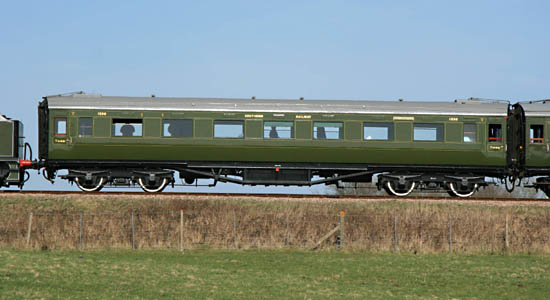
Open Third No. 1336, (Built 1933)
Thanks to the weakness whereby the droplights prevent the body from being watertight, the work has involved the replacement of a majority of the body timbers, starting from the bottom sides running the length of the vehicle. To achieve the required repairs, the entire body has been completely dismantled and re-assembled. It will thus be pretty-much the most extensive carriage overhaul yet undertaken by a heritage railway.
A separate web page features the overhaul of this carriage in detail.
Composite Dining Saloon / Open Third No. 1365
This coach, initially obtained to provide seating in the restaurant at Sheffield Park, was subsequently pressed into service on our trains for a number of years in the seventies. It sheltered for many years under tarpaulins on the Ardingly spur, and has now moved into the OP4 storage shed, where it remains in excellent condition, a very good prospect for a future restoration.
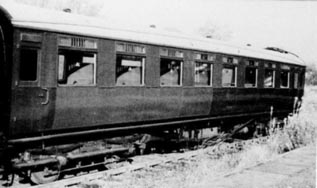
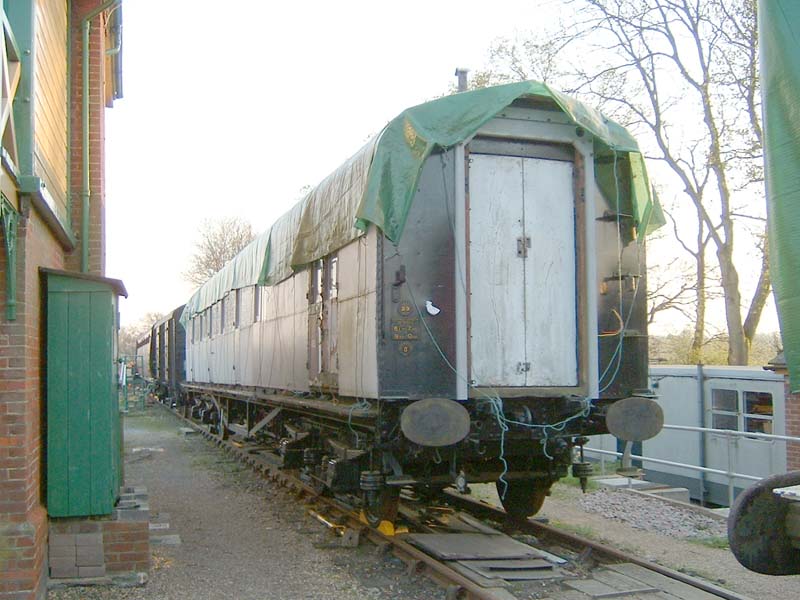
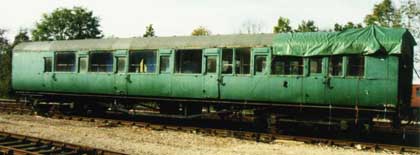
Corridor Third No. 2356 (Built 1931)
Its restoration is possible in the very long term, although a new interior would have to be constructed, along with an almost completely new body structure. It is unique as the only surviving steam-hauled SR corridor third.
[Postscript - February 2023: Following a re-appraisal of our carriage fleet in 2021, since this carriage arrived not for preservation but simply to provide messing facilities, as a R1 vehicle did not fit our planned Maunsell train, and was in such a poor structural condition that it had had to be propped up internally to porevent collapse, it was offered for sale, and after 18 months without finding a new home was sold out of preservation.]
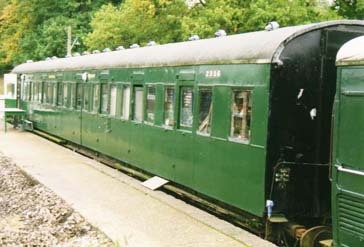
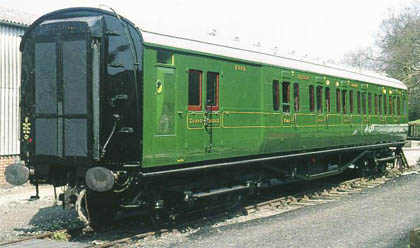
Corridor Brake Third No. 3687 (Built 1931 for Hastings Line)
Finally entering the carriage works in 2019, a concerted effort was then made to complete the restoration of this vehicle, which will be at home behind the contemporary Hastings-gauge Schools-class locomotive 'Stowe', and matches the profile of our SECR Hundred Seaters.
A separate web page features the overhaul of this carriage in detail.
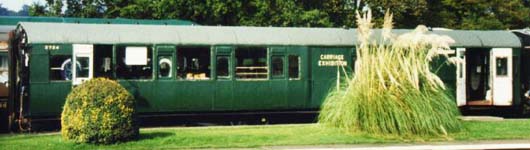
Corridor Brake Third No. 3724 (Built 1930)
[Postscript - February 2023: Following a re-appraisal of our carriage fleet in 2021, since this carriage arrived not for preservation, it was offered for sale, but after 18 months without finding a new home, its future is being re-appraised, as a potential wheelchair accessible vehicle instead of or as well as 4441.]
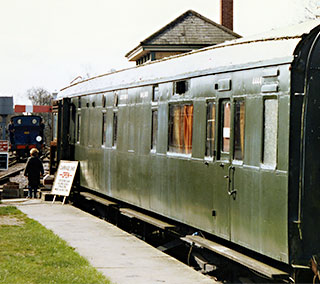
Unclassed Brake No. 4441 (Built 1933)
[Postscript - February 2023: With underframe repairs now routine, it's no longer thought necessary to swap underframes. It is planned that this would be an ideal carriage to be used for wheelchair access, since this can be easily achieved through the double doors into the adjoining saloon, with no external modifications to the original design required.]
Unclassed Brake No. 4444 (Built 1933)
[Postscript - February 2023: Due to its seriously deteriorated condition, the long-planned dismantling of this carriage took place in 2021. Its bogies went to Petworth to carry the body of Pullman 'Princess Ena' and unfortunately the underframe, which was in good condition, was damaged beyond re-use during dismantling.]
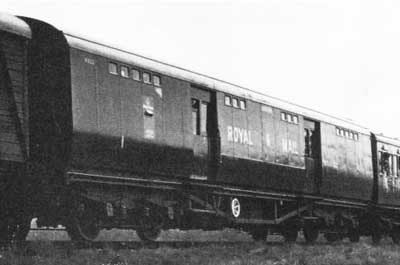
Travelling Post Office No. 4922 (Built 1939)
[Postscript - February 2023: Following a re-appraisal of our carriage fleet in 2021, since this carriage had attracted no interest over the preceding 35 years, and was in a poor structural condition, it was offered for sale, and after 18 months without finding a new home was sold out of preservation. The identical No. 4920 was in the National Collection, but is now preserved on the Nene Valley Railway.]
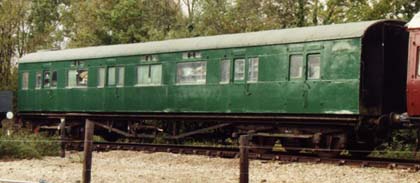
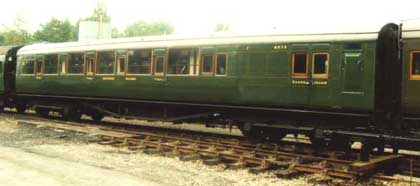
Corridor Composite No. 5644 (Built 1930)
Corridor Brake Composite No. 6575 (Built 1929)
Corridor Brake Composite No. 6686 (Built 1935)
Kitchen Buffet No. 7864 (Built 1932)
Used for many years as the first Sheffield Park Buffet, this coach, substantially modified and devoid of its original interior, and suffering from having sat unused for the two decades, is unfortunately a shadow of its former self.
Its restoration was considered in the 1990s by a group of volunteers involved in on-train catering, but nothing came of that; as an important and potentially useful carriage, it is certainly on the "must do" list of eventual restorations. Whilst the bottom-side has given way, the main body structure of the coach is actually in better condition than several of the others above.
Money towards its overhaul has been collected over many years, but in 2008 this stepped up a gear, and enough money is now to hand to commence the overhaul during 2023.
The underframe from coach No. 3725 was held for many years as a spare, but was subsequently scrapped after fire damage. Several spare bogies were obtained from car-carriers which had been converted from the underframes of Maunsell-period coaches. On to the next article in this series.

Return to BRPS Home Page, to the Timetable or to Special Events Carriages & Wagons - Intro - Development - Stock Lists: Carriages & Wagons - Carriage Fleet Review - Join us C&W Works News - SR Coach Group - Goods Division - Operation Undercover - Carriage Shop - Technical Pages Visitor Info. - Museum - Trust - Catering - Contacts - What's New - Projects - Locos - Carriages & Wagons - Signals - History - Other - Links - Search - FAQ Why not become a BRPS Member? - Get more involved as a Volunteer  Copyright © 27 January 1996.
Last update 12 February 2023 by Richard Salmon. © Copyright BRPS. Privacy Policy |