C&W -
Stock Lists: Carriages & Wagons -
C&W News - SR Coach Group - Goods Division -
Operation Undercover -
Technical -
Join us


The Development of the British Railway Carriage
The railway carriage developed out of the stage coach in the 1830's. Originally the classes of travel were the same. First and second class were enclosed, with first class having upholstered seats. Third class passengers (who travelled outside on a stage-coach) were only provided with benches in open wagons. Luggage was carried on the roof, and the guard sat on the roof on the end of the coach.
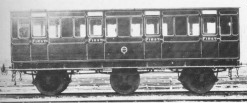 As the years went by, greater comforts were added. The third class and the guard and luggage were accommodated inside the coaches, and six-wheeled coaches, giving a smoother ride than the older four-wheeled types, were introduced (as in the photo, Right, of a First Class coach of the London, Brighton & South Coast Railway built in 1880).
Heating was provided using steam from the engine (where previously passengers could hire hot-water bottles and blankets at stations). To improve safety, trains started to have "continuous" brakes on all coaches controlled by the driver, rather than just a hand brake controlled by the guard, and a "communication cord" by which passengers could raise an alarm. Lighting was originally by oil lamp, very dingy. Some coaches (such as our Great Northern Railway directors' saloon Below) had "clerestory" roofs with windows in them to let more light into the centre of the coach.
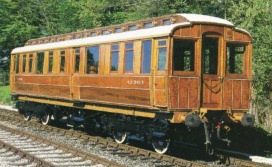
GNR Directors' Saloon of 1897, with Clerestory roof.
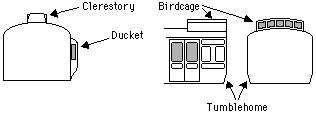 In his brake coach, the guard was able to keep a lookout along the train using either a "birdcage" on the roof, or a "ducket" at the side.
By 1900 "Bogie" coaches were being introduced, that is, the type of coach we know today, carried on a small 4-wheeled "bogie" at each end. This provided much greater comfort, due to a smoother ride, thanks to having both primary "suspension" (springs) between the wheels and the bogies, and secondary suspension between the bogies and the coach. In addition, it allowed coaches to corner more smoothly. Gas lighting had replaced oil, but after some horrendous fires following accidents the railways started to use electric lighting. Our four Metropolitan Railway coaches, the last of which is currently under repair in the carriage shed, were some of the very first to be electrically lit. On these though you can still see the stage-coach influence, in the "tumblehome" at the ends of the coaches.
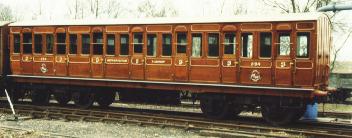
A Metropolitan Railway coach, an early "Bogie Coach"
Originally coaches had wooden underframes. Sometimes these were strengthened using steel "fitch plates" on either side of the wood. Around the end of the 19th century all-steel underframes were introduced, at first riveted, and then, from the 1930s welding became common. Until the advent of the "monocoque" steel coaches of the 1970s, this underframe was separate from the body. In monocoque construction the structure of the coach is integrated as a complete unit, all the strength being built into the body, with no separate underframe.
The coach body was originally wooden framed, using teak, ash or oak, and panelled with wood, such as our London & North Western Observation Car of 1913. By the 1920s it was common for coaches to be wooden framed, but with steel panelling. The majority of the coaches running on the Bluebell Railway are like this. After the Second World War, the structural framing also became steel, as in our British Railways Mark 1 coaches, such as the two buffet cars. To bring the story right up to date, the very latest coaches, built in the last few years, are of aluminium construction.
By the 1950s the guard had a periscope with which to look along the train and observe signals. Electric heating (using power supplied from an electric or diesel locomotive) and air (rather than vacuum) brakes started to be fitted. Second class was abolished in the early years of the 20th century, with the exception of trains to the channel ports for ferry services which still retained second class. Thus most railways had only first and third classes, until 1956 when third was re-named second (now "standard").
Seating and passenger facilities
The following diagrams help explain the development in the design and layout of the railway coach over the years, with examples of different configurations.
Originally seats were in individual compartments, with no way of getting from one to another.
1880s: 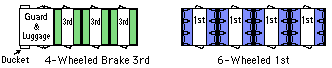
As the railways started to provide lavatories, these were initially placed between compartments, often not serving all compartments.
1900s:
Later, it was realised that an entire coach could be served by one or two lavatories, by the provision of an internal corridor.
1900s: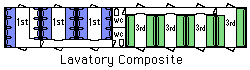
With the introduction of restaurant cars around the start of the 20th century, it became advantageous to pass down the length of a train. This was achieved by linking the corridors of adjacent coaches using a "corridor connector".
1920s: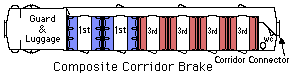
However, many coaches continued to be built, right into the 1950s, without corridors or toilets, for short-distance commuter traffic. By the sixties, it was thought better to have open coaches for commuter work, for two reasons. Firstly, there were safety concerns over being isolated in a compartment, unable to escape in the event of the presence of an unsavoury fellow passenger. Secondly, it allowed passengers to join the train through the most convenient door, and then find a seat further down the carriage. The provision of up to 10 doors per carriage side persisted, since this allowed faster loading and unloading, important for fast-turn-around commuter services. The last such stock was built in the 1970s, and subsequently, with the advent of sliding power-operated doors, with only two double-doors per carriage side, commuter services are rather slower to load than the "obsolete" slam-door stock.
Some coaches, known as "brake coaches", had a compartment set aside for the guard, and also a luggage space. In the days when families used to go on holiday by train there was a vast amount of luggage to be carried, and up to half of the brake coach could be given over to luggage, with half the coaches in the train being brakes!
Coaches were designated by class, by corridor arrangement, and by lavatory provision. A composite coach was one with seating for both first and third class. In the days of second class there were "Tri-composites" with all three. The Midland Railway, towards the end of the 19th century, abolished second class, improving its third class seating to the same standard as second had been, and reduced the fares in first class. The other railway companies reluctantly followed suit, so as not to appear behind the times. First class compartments usually sat six (or sometimes eight if there was no corridor), and had arm-rests and more space than third class, which seated 8 (10 or even 12 if no corridor) per compartment. In 1956 third class was re-named "second", and in the last decade of the 20th century, "standard".
In the 1920s and '30s the compartment started to give way to the "open" seating layout.
1930s: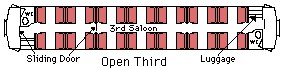
Also, note the reduction in the number of doors on these coaches, intended for longer distance journeys.
The doors are always an expensive and time-consuming part of a coach to construct and maintain,
and could be draughty and, at higher speeds, make the interior more noisy.
1940s/50s: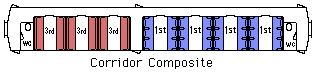
Even in the 1950s and '60s side corridor coaches continued to be built in large numbers,
although open vehicles were fast becoming the norm.
1950s/60s: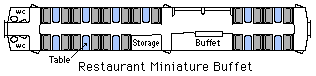


Return to BRPS Home Page,
to the Timetable or to Special
Events
Carriages & Wagons -
Intro -
Development -
Stock Lists: Carriages & Wagons -
Carriage Fleet Review -
Join us
C&W Works News - SR Coach Group - Goods Division -
Operation Undercover -
Carriage Shop -
Technical Pages
Visitor Info. -
Museum -
Trust -
Catering -
Contacts -
What's New -
Projects -
Locos -
Carriages & Wagons -
Signals -
History -
Other -
Links -
Search -
FAQ
Why not become a BRPS Member? -
Get more involved as a Volunteer
Your ideal Film/TV location?
 Copyright © November 1997 by Richard Salmon.
Last updated 25 January 2019 by Richard Salmon.
© Copyright BRPS. Privacy Policy
|