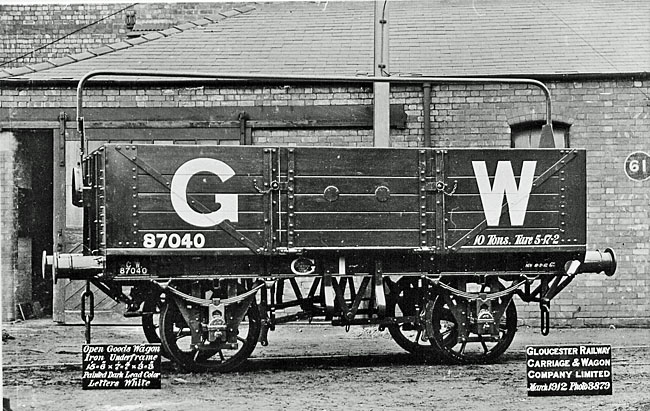
This 10-ton capacity 5-plank vehicle was built for the Great Western Railway by the Gloucester
Carriage and Wagon Company. It was one of a thousand (Nos. 87001-88000) in Lot 697, which was ordered
on 20 October 1911 and completed on 28 December 1912. 87782, which was completed during week ending
23 November 1912, is thus a pre-Grouping vehicle. The average cost per wagon was £112.
10,815 of these vehicles were built by or for the GWR to their diagram O11, and they were known by
the telegraphic code "OPEN A".
No.87782 is fitted with a handbrake only, this being of the Dean/Churchward ratchet type (as the
name suggests this was designed by GWR mechanical engineers; it was widely used by the GWR but rarely
by other railways). It thus had a relatively low original tare (empty) weight of 5 tons 18 cwt 0 qtr,
although it was marked 5 tons 17 cwt on arrival at the Bluebell Railway.
The wagon was originally fitted with a sheet support rail. At the Grouping in 1923 most goods were
carried in open wagons, those containing goods that required some protection being covered with a
tarpaulin sheet. To prevent water accumulating in hollows and leaking onto the goods, many wagons
were fitted with a sheet support which allowed water to run off.
During the Great War (1914-1918) a number of locomotives and wagons were taken over by the military
for use overseas. 87782 was requisitioned on 21 February 1917 and was returned to the GWR on 11 April
1920. Our wagon is thus a veteran of the Great War!
Notes on 87782 from the GWR Wagon Register (now in the NRM, York):
Type: Open goods
Body: Wood
Length: 15' 6"
Width: 7' 7"
Height: 3' 3"
Frame: Iron
Length of spring: 3' 4 1/4"
Axles -
Length between centres of journals: 6' 6"
Size of journals 8" x 3 3/4"
Diameter through boss of wheels: 5 1/4"
Diameter in middle: 4 3/4"
Wheels -
No: Four
Diameter: 3' 1 1/2"
Base: 9' 0"
Buffers: Self-contained
Drawgear: Special through
Brake: RH either side
Stabled Corr(espondence reference) 89492. Repaired and returned to traffic Corr No. 96435 11/5/32
Haywoods Slack Adjuster Sw(indon) 7.1.39
W87782 was condemned on the London Midland Region on 21 February 1959 and sold by BR to the Port of
Bristol Authority on 26 December 1959. It was renumbered PBA 59627 and continued in service within the
docks until the late 1970s, after which it was purchased for the Bluebell Railway by Neil Cameron,
arriving with other vehicles from Bristol Docks in June 1981.
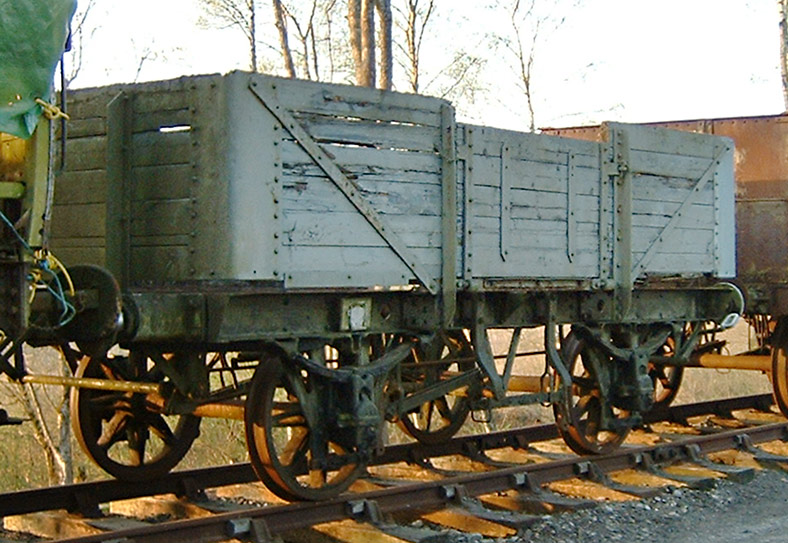
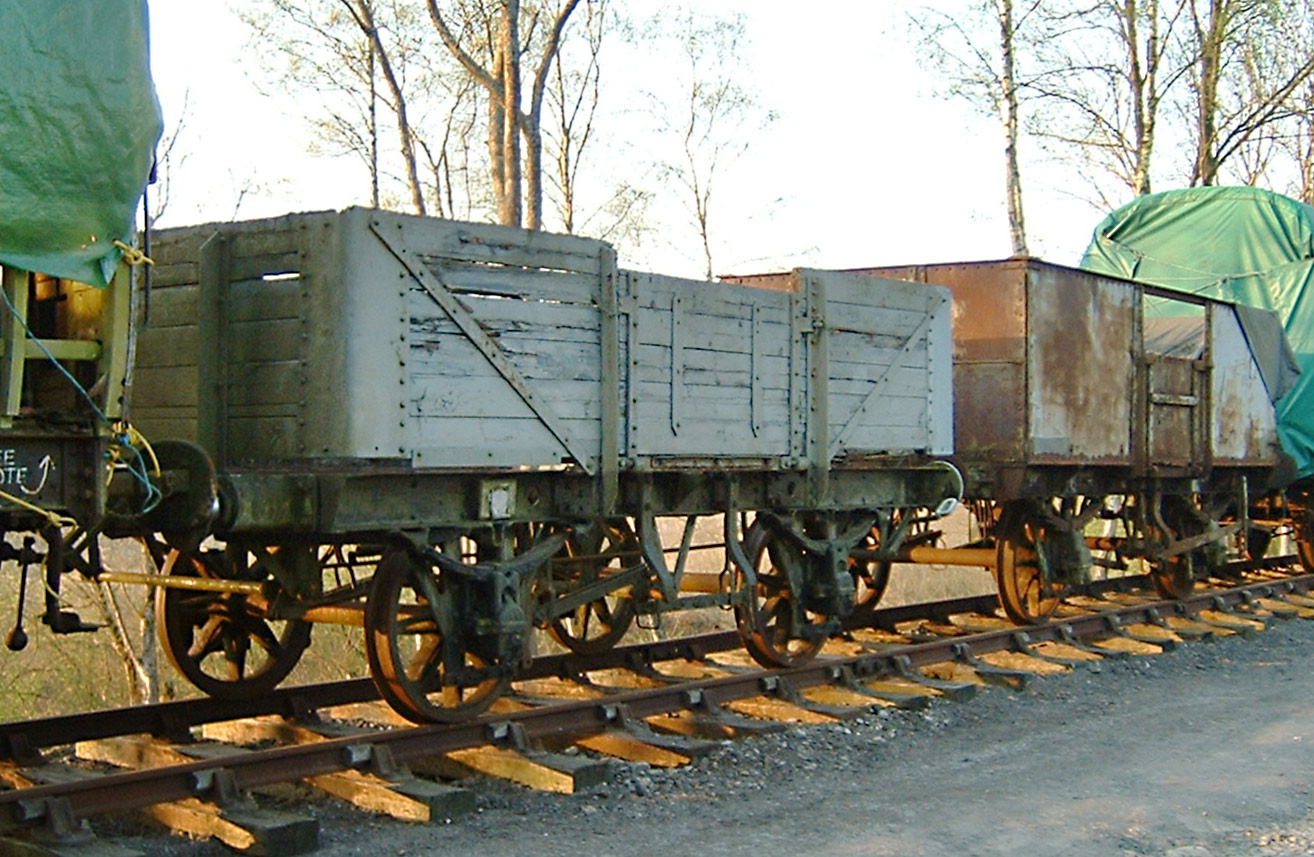
GW 87782 prior to restoration in April 2003. Richard Salmon
The wagons at Bristol were regularly damaged and repaired. This one has been fitted with replacement
headstocks and substitute door pillars on one side. The original GWR self-contained buffers were
replaced with Dowty pneumatic buffers. The solebars and underframe on this wagon are in particularly
good condition, considering that it is over 100 years old!
With almost 11,000 of these wagons in service they would have travelled widely, and would have been
regular visitors to the Southern Railway area over a 40-year period. Thus one would certainly not be
out of place in one of Bluebell's goods trains.
The restoration project is being funded through donations to the Bluebell Railway Trust. Details of
how you can help with the funding of the restoration are included on
this web page,
which contains full details and photos of progress with the wagon's restoration, which commenced in
September 2009.
Recommended reading:
GWR Goods Wagons by A.G. Atkins, W. Beard & R. Tourret (Oxford Publishing Co. 2013)
ISBN-10: 0860936570. ISBN-13: 978-0860936572.
This may be available from the Bluebell Shop at Sheffield Park.
Used, older editions of this book may be available in the Carriage Shop at Horsted Keynes.