There are about seventy coaches in the collection, of which some
thirty are currently in regular service. Some arrived on the railway
in a condition where they were fit for immediate use; however most of
these have since required major repairs as age has taken its toll.
Some were converted to dwellings in the 1920s and '30s as grounded
bodies. Others were gutted when withdrawn by British Rail, and
modified for use as offices, classrooms, or used in weed-killer
trains. Some of these have since been restored to original condition.
In addition, the Railway has a large number of vans and goods wagons, some of which have been
overhauled, while others are awaiting restoration. Some, such as the
ballast and sleeper wagons, continue to perform their intended
functions on engineering trains. There are also a number of sleeping
coaches, providing overnight accommodation for volunteer staff, and
others which are used as shops or exhibition spaces, or as mess rooms.
The following is a summary of the coaching stock which is in service,
together with brief details of the rest of the collection. A full list of our coaches is also
available, as is a more detailed Review
of the Carriage Fleet.
Victorian Coaches
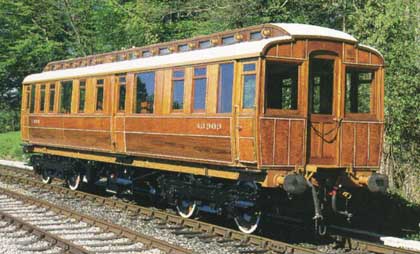 43909, the Great Northern Railway
Directors' Saloon has a varnished teak finish and a fine "clerestory"
roof. Over the last decade its owning group have undertaken a
major refurbishment of the coach, which is now turned out in its LNER
condition. You may find it running in public use (for first class
ticket holders) on the third weekend of the month, and other special weekends.
43909, the Great Northern Railway
Directors' Saloon has a varnished teak finish and a fine "clerestory"
roof. Over the last decade its owning group have undertaken a
major refurbishment of the coach, which is now turned out in its LNER
condition. You may find it running in public use (for first class
ticket holders) on the third weekend of the month, and other special weekends.
We have a set of four Metropolitan Railway
coaches, known as the Ashbury Stock, or the Chesham Set. These
coaches carried the majority of the Bluebell's passengers in the
early sixties, but from 1967 they were stored out of use,
except for the occasional outing for filming work. Between 1992 and 2006 the volunteer-led
restoration of these coaches has seen a
transformation from stripped out shells (due to dry and wet rot) into
magnificently restored period pieces. A sum of £40,000 was
raised, covering the costs of materials.
 The first two, the guard's brake coach, 387, and the
seven-compartment third class coach 394 were completed in
January 1999. The overhaul of the two other coaches, "composites"
with both first and third class compartments, was then started, with
368 returning to service in May 2002, and 412 completed in December 2006.
The first two, the guard's brake coach, 387, and the
seven-compartment third class coach 394 were completed in
January 1999. The overhaul of the two other coaches, "composites"
with both first and third class compartments, was then started, with
368 returning to service in May 2002, and 412 completed in December 2006.
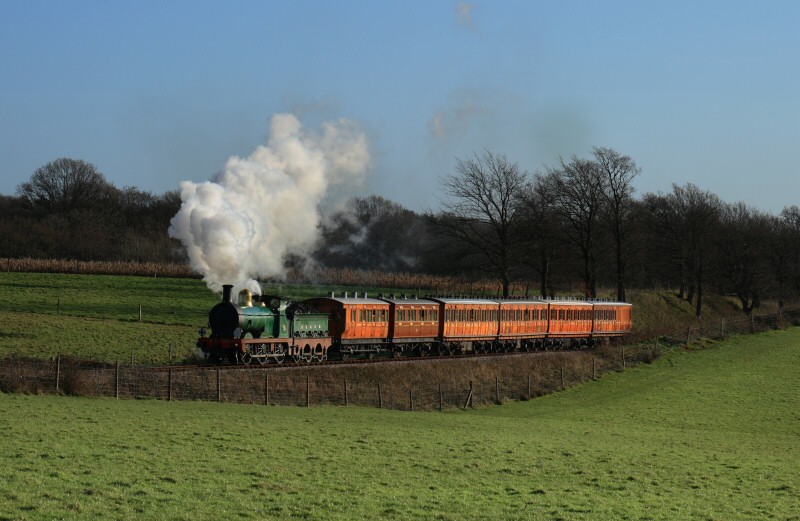
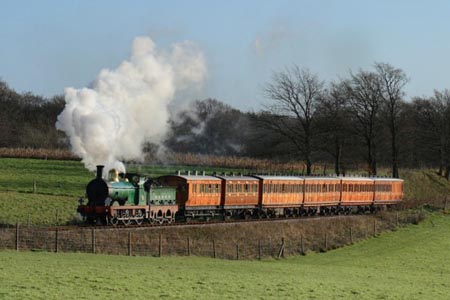
The photo (from Jon Bowers) shows the four Metropolitan coaches, together with LBSCR 661 and LCDR 114
Our oldest coaches are all from the London, Brighton & South
Coast Railway. A very early (Craven era) 4-compartment second,
built in 1856, is safely stored away as a kit of parts for eventual
reconstruction, and a relatively complete 1858-built lantern-roofed full brake, 1860's first and a second brake have also been aquired. Another five are Stroudley
coaches built between 1875 and 1890. One is a 4-compartment first
class coach, No.661. The
restoration work on this coach was funded by the Bluebell Railway
Trust, and conducted by a small team of volunteers. The body of this coach was grounded as a
bungalow, but is now mounted on a suitably modified underframe, and returned to service in July 2004. Stroudley Brake No.949 arrived in May 1998, and has three
compartments and distinctive shaped guard's duckets, where the body
of the coach is widened to allow the guard to look along the length
of the train. Its restoration started in 2004, with an underframe prepared in advance to receive the rebuilt body. The other three Stroudley carriages are another brake and two five-compartment thirds. The restoration of 328 started with the preparation of an underframe for it in 2009. The aim is to create a complete 19th-century LBSCR set, to run with our Stroudley Terriers, 'Stepney' and 'Fenchurch'.
There are also four London Chatham & Dover
Railway coaches, two six-wheelers and two
four-wheelers. All four were brake vehicles, having, as well as passenger
compartments, space for luggage and the guard. Brake Third,
No.114, once a grounded body used as a bungalow, has been fitted to a shortened SR van underframe prepared for it. It returned to traffic in November 2006. Because we don't need four brake vehicles, 3360 has been modified (with funding from the Big Lottery through the People's Millions program) as a wheel-chair-accesible semi-saloon, completed in 2011, when the overhaul of 3188 started. This coach, having been built as a 5-compartment third and converted to a brake vehicle about 1910, has been rebuilt back to its original condition and returned to service in June 2016. In 2010 we recovered a South Eastern Railway first-class saloon body, No.172, which will provide the first-class for an eventual SECR-liveried set with the LCDR carriages, to run with our SECR locos. In 2017 a further two SER carriage bodies arrived, a 6-compartment third and a brake third, which will nicely enable a complete SECR-liveried 6 coach set.
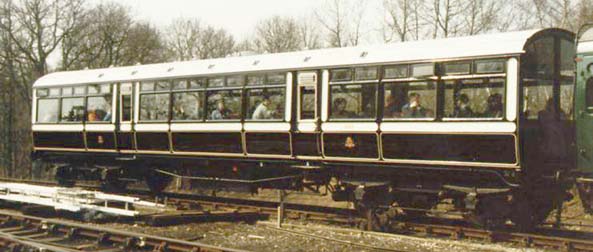 One of three double-ended "observation coaches" built for the
scenic North Wales line, the 1913-built 1503 has run on the
Bluebell since 1963. Between 1978 and 1982 it was rebuilt to its
original condition. The work involved separating the body from the
underframe, and constructing an entirely new floor. New doors and
window frames were fitted, and the sides re-panelled. Two years
later it was highly commended in the first ARPS Coach of the Year
competition. In November 1998 it received some new bodyside panels
and was repainted into LMS period 3 maroon livery, as it would have
been in the 1940s, and further work involving repanelling, retrimming and re-glazing saw it return to LNWR livery in 2004.
One of three double-ended "observation coaches" built for the
scenic North Wales line, the 1913-built 1503 has run on the
Bluebell since 1963. Between 1978 and 1982 it was rebuilt to its
original condition. The work involved separating the body from the
underframe, and constructing an entirely new floor. New doors and
window frames were fitted, and the sides re-panelled. Two years
later it was highly commended in the first ARPS Coach of the Year
competition. In November 1998 it received some new bodyside panels
and was repainted into LMS period 3 maroon livery, as it would have
been in the 1940s, and further work involving repanelling, retrimming and re-glazing saw it return to LNWR livery in 2004.
Apart from the Stroudley and Craven-era coaches mentioned above, we have two other
coaches from the railway which originally operated our line. One is
the lavish 12-wheeled Directors' Saloon (No. 60) , which has
spent the last thirty years out of use awaiting repairs.
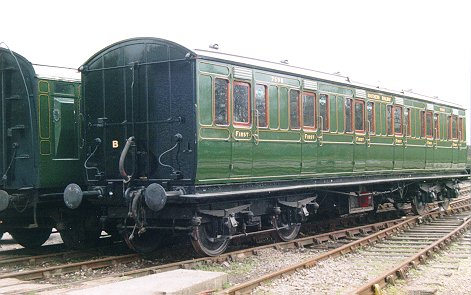 LBSCR First 7598, after restoration at Horsted Keynes.
The other is 7598, a first class coach which, like 661, was
used as a bungalow for the best part of sixty years. It was selected
for preservation because the structure of the coach was sound, but
all the panelling and interior has had to be reconstructed. Many
components were acquired from similar coach bodies which were not
complete or restorable. A suitable underframe and bogies were
modified and repaired to take the body.
This was the
first bogie-coach body, fitted to a modified underframe on a
preserved railway to return to passenger service. The coach was
"rehabilitated" by volunteers over a period of seven years, entering
service in May 1999 carrying the Southern Railway livery of the
1920s. There is a separate web page for
this coach.
London & South Western Railway
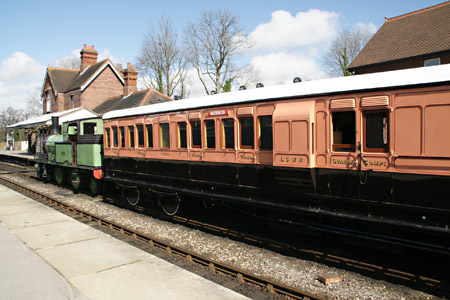
LSWR Brake Third No.1520, at its re-launch - 26 March 2010 (Alex Morley)
In addition to the body of an 1885 saloon, we have three coaches built by the LSWR in the early years of the
20th century. One of them was in the Bluebell's first train,
purchased in 1960. Another, 1520, was used for many years in
our Fire Train. This third-class brake coach has been splendidly restored by a team of
volunteers for passenger use, as is seen here in Alex Morley's photo showing it on the day of its formal re-launch into service, which coincided with its centenary, in March 2010.
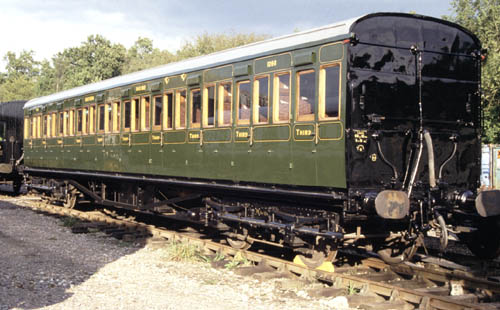 Coach No.1098, built in 1922, seen here after its 1994 overhaul.
971 and 1098 can each carry 100 third class passengers
in ten separate compartments. 1098 received an overhaul in 1994,
involving repairs to the doors and body structure, and re-cladding of
the exterior. In 1997, 971 received a new
roof canvas, and then joined 1098 in the 1930s' lined olive green
livery, as well as having through lighting control fitted to ease use
of these coaches on runs through our tunnel. More details are
available on these coaches on a separate
web page. 971 is currently out of service pending an overhaul. This is the first major work that has had to be done
on it after 44 years running on the Bluebell!.
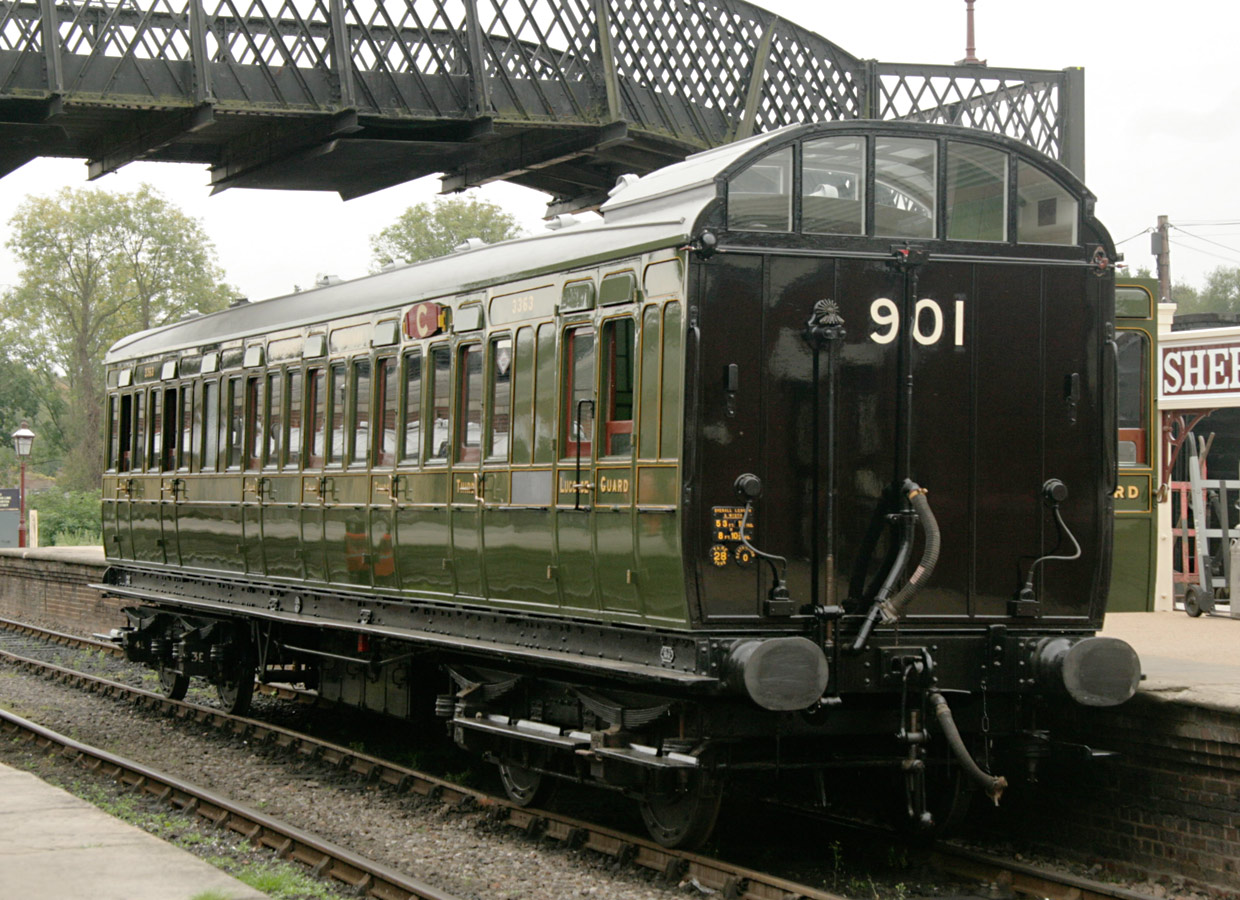
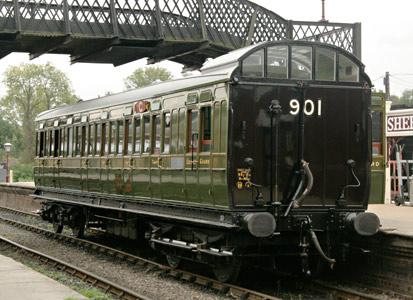 SECR Brake coach No.3363, showing the "Birdcage" end
which provides the guard with a view along the train. (Dave Clarke)
SECR Brake coach No.3363, showing the "Birdcage" end
which provides the guard with a view along the train. (Dave Clarke)
The restoration of an SECR "Birdcage brake", SR No.3363, started
at the end of 1999. This is the guard's brake coach for the SR-liveried vintage set, following completion in October 2011.
Three further coaches are in storage in our sidings. These will
eventually form a "Birdcage Trio Set", so called because the brake
coaches at each end of the set have a raised birdcage lookout for the
guard. Two of these ran in Bluebell trains in the 1960s and 70s, but
are now out of service awaiting major repairs, whilst the third was
stripped out whilst in departmental service on British Railways.
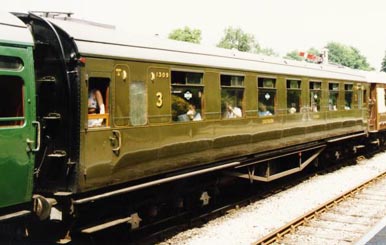 Award-winning Maunsell Open Third No.1309.
When the Southern Railway was formed in 1923 by the grouping of the
latter three companies above, Richard Maunsell, the new Chief
Mechanical Engineer, produced a distinctive and somewhat improved set
of coach designs. We have a collection of thirteen of these coaches,
including a restaurant and kitchen car pair and a travelling post
office. At present three have been fully overhauled and run in the
Southern's 1930s lined olive green livery, although one of these is
currently not in regular service, having suffered water penetration,
and is awaiting remedial attention.
6575 is a brake composite built in 1929. It was one of two
coaches in the Bluebell's very first train in 1960. It received a
major overhaul between 1979 and 1981, and is notable for the high
windows on the corridor side of the vehicle. It is now out of service awaiting
further attention.
1309, a third class saloon coach of 1935, was restored to
original condition, having been stripped of its interior before
arrival on the Bluebell. Its restoration in 1984 earned the
department the first ever national "Coach of the Year" Award.
6686, another brake composite like 6575, but built to the
later 1935 pattern without external window frames, has recently
undergone a comprehensive overhaul, which has involved the
replacement of much of the structural woodwork. It was "Highly
Commended" in the Heritage Railway Association's 1998-9 Carriage
Awards.
1336, a "drop-light" open third, returned to service at the end of 2008, after a decade-long overhaul, which involved the complete dismantling of
the coach body to a bare underframe, and building the coach back up
from there with many new structural timbers in place of originals
which were badly split.
Other Maunsell coaches returning to traffic over the next few years
should be the Hastings-line brake third 3687, which is only 8'
wide, due to very restricted tunnel clearances on that line, and
the Kitchen restaurant car 7864 for which fund raising is now under way.
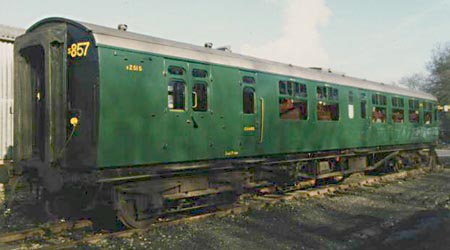 Bulleid Brake No. 2515 of 1951.
Coaches built to the post-war designs of Oliver Bulleid form the
backbone of the Bluebell's operating fleet, having been overhauled
and returned to traffic in the mid seventies and early eighties. At
one time we had six of these coaches in service, but this is now
reduced to four, with two, which had not received heavy "Bluebell"
overhauls, having suffered damage from water penetration causing
their withdrawal from service awaiting repairs.
We currently have one brake coach in service, 2526, two third class saloons, 1464 and
1482, together with Composite 5768 which ran on the Bluebell between 1976 and 1994, and does again since the completion of a comprehensive overhaul in 2019. Open Third 1481 and brake thirds 2515 and 4279 were each in Bluebell
service for over 25 years, but are now stored awaiting further overhauls. During 2005 and early 2006 No.1464 (which was originally restored to service in 1986) received an intermediate overhaul of external panelling and window frames.
A further brake coach is in storage pending restoration, and Open Third 1456 is on long-term loan to the Mid Hants Railway, where it has been restored to service thanks to a NHLF grant.
The brake coaches are unusual in having an open saloon section and
two compartments. The Southern Railway provided this mixture as a
result of a passenger survey which they had conducted. The deeply
sprung and padded seats in these coaches are probably the most
comfortable ever provided for ordinary passengers.
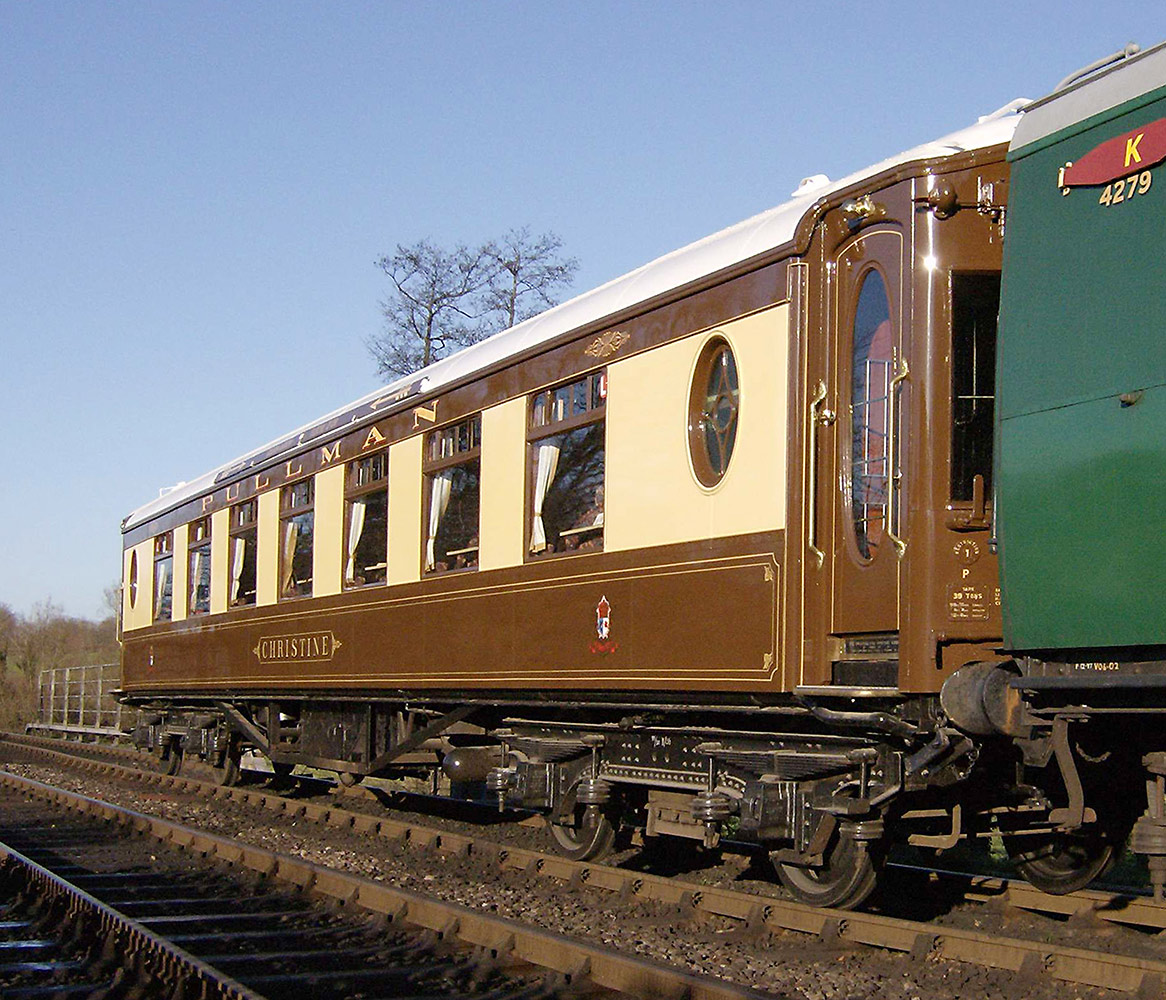
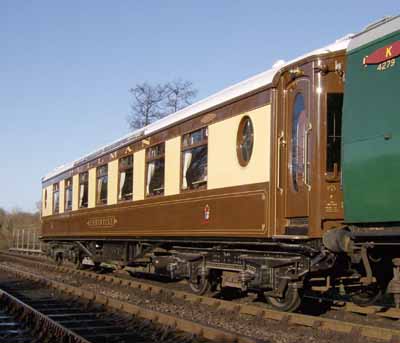 Pullman Car 64 "Christine" (Andrew Strongitharm)
The Pullman Car Company built and operated their own "cars" (the
American word for coaches) to provide luxury dining services on
trains operated by various railway companies. There are seven Pullmans
on the Bluebell, mostly dating from the 1920s.
The first to enter service on the Railway was Car No. 64, a
third class saloon seating 42. It ran for about 15 years before requiring a major overhaul, which was completed in 2006. It now runs carrying the name "Christine" as it did in its days on the Bulmer's promotional "Cider Train".
"Fingall" entered traffic in 1992 after a comprehensive
overhaul. Seating 22 first class diners in individual arm chairs,
she is the ultimate in luxury. The overhaul also included a
completely new kitchen, fitted out to modern catering standards. Between 2010 and 2014 it received major repairs to its roof and upper body sides, where water penetration had caused some timbers to rot.
Pullman Car No.76, which ran as "Lilian", was made watertight for
us at Stewarts Lane and entered traffic in 1997, but has, since 2014, been out of service requiring a very major overhaul, and has now been sold. Car No.54 is a Pullman brake coach, and now addapted to provide wheelchair access, returns to service in 2023 following our most comprehensive Pullman overhaul yet.
To provide extra kitchen facilities following the departure of
"Bertha", a Met-Cam Pullman Kitchen First, "Eagle", was
hired between 2000 and 2008 from the National Railway Museum. "Doris", a 1932-built "Brighton Belle" electric car, formerly located at Finsbury Park, was purchased by the Bluebell with the intention that, with its kitchen facilities, it will be a useful part of the Pullman train. In the interim, the LMS BGZ brake (below) has been equipped with limited facilities, but "Doris" has now been exchanged, via the 5BEL Trust, for Golden Arrow First-class kitchen car "Carina", but it's place has been taken in the restoration queue with the purchase of similar kitchen car "Aquila".
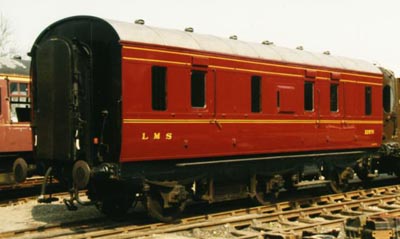
The LMS Stove R after restoration.
32975 is a six-wheeled gangwayed guard's brake coach (known as
a BGZ or Stove R), built in 1938. It is normally used as the brake
vehicle for our Pullman train. It warrants special mention as, after
its restoration, it received the 1996/7 Heritage Railways Association
Coach Award, our third of these top national awards. During 2008 it received an interior modification to enable it to provide pantry services to the Golden Arrow train, including a hot water system, steam heating, and washing-up facilities. This is intended as a temporary, and completely reversible, modification until another pullman kitchen car is able to be overhauled. It released "Eagle" to enable that carriage to be returned to the NRM, and is now painted temporarily in Pullman colours.
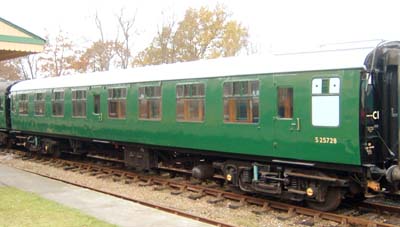 Corridor Second No.25728, after its repaint into Green.
The most modern stock on the line at around 60 years old, the BR
standard Mk.I coach was stylistically influenced by the SR Bulleid
stock. However, its structure is of steel, whereas the older stock
is wooden bodied with external steel sheeting. Compared to most
other heritage railways, the Bluebell has relatively few of these
vehicles, instead being able to run older vehicles, more typical of
the steam era. These vehicles were mostly, in fact, built after our
line was closed by British Railways!
1818 and 1838 are RMBs (Restaurant Miniature Buffets)
providing on-train refreshment facilities, restored in the 1980s, and have now received further major maintenance attention. 16210 is a
corridor composite coach, of very similar interior layout to the
Southern Railway Bulleid design. This has been most comprehensively
and expertly renovated, and entered service in late 1991.
Second class compartment coaches 25728 and 25769, and open
second 4957 have received structural overhauls in our workshops, but the
latter will be replaced by open second
4754, once this carriage (ex-Bicester Military Railway) is returned to service. 48-seat Open Second (SO) 4824 and Open First 3064 arrived on the railway in 2007 after overhauls elsewhere, but have had considerable work done to prepare them to provide a suitable environment for our christmas services, in addition to use in our Wealden Rambler Lounge Car train. Kitchen car 1674 arrived on loan in 2011 to cover for Pullman "Fingall" and then use as a support vehicle for the Wealden Rambler. Other Mk.1 coaches which we run, after overhaul elsewhere, are composite 16012 and brake seconds 34556 and 35207, which have been restored to early BR crimson lake and cream livery. BCK 21246 was acquired in 2011 as an additional brake vehicle for our main service trains, and entered service in 2018.
5034 is a former 64-seat SO, subsequently converted into a dormitory
for the former Travelling College train. This vehicle was rebuilt during 1998 as a multi-purpose saloon with
wheelchair access, with 4941 now adapted in the same way.
The Bluebell Railway's Carriage and Wagon Department, a mixture of
volunteers and full time staff, is responsible for the restoration
and maintenance of the Bluebell Railway's coaching and goods stock.
The department always welcomes new
volunteers. If you feel inspired to help with the maintenance or
renovation of one of this country's most historic collections of
railway coaches, feel free to introduce yourself to any of the
volunteers working in the shed at Horsted Keynes. They will be
pleased to put a screwdriver or paintbrush in your hand and set you
to work! There is a great variety of work within the department,
painting and varnishing, electrical, mechanical, woodwork, metalwork,
polishing, upholstery... But the most rewarding part is sitting in
the coach you have helped to restore as it ventures down the line for
its first test run!
The Bluebell Railway Goods Division is an initiative by younger members of the Railway to revitalise our wagon fleet. and great progress has been made in a relatively short time.

You might be interested in the Development of
the British Railway Carriage.


 Copyright © 7 October 1995.